jueves, 13 de junio de 2013

Z Fish Report (6/13/13)

John Lorenz of Casa Bahia Tortuga in Puerto Vicente Gro.
with his fly caught sailfish 
Our summer pattern has settled in, with the 85° blue water just off the beach, and very decent fishing all around. Offshore the sailfish, striped marlin, and blue marlin are mostly being caught between the 8 to 10 miles marks off the beach. Most boats are averaging 2 to 3 sailfish a day, with there always being a shot at a blue or dorado.
Tommy Harris with one of 5 sailfish on the Gitana
Tommy Harris from Houston, Texas conventional gear fished with Santiago on the super panga Gitana for two days, tagging and releasing 5 sailfish and a 150 pound striped marlin in two days of fishing.  Tommy’s fly fishing partner, Inge Solberg of Houston also tagged and released two sailfish on the fly.
Inge with his fly caught sailfish
The inshore action is not showing the large numbers of roosterfish we usually expect in June, but they are huge. Adolfo, on the panga Dos Hermanos had a large group from France here all last week, chartering 5 pangas. They all fished the inshore and averaged 2 to 3 roosters a day. The roosters averaged 40 pounds, with several each day estimated in the 50 and 60 pound class.
After Don Gallagher of California fished offshore and released
a sailfish with the fly rod with John Lorenz, they came up on
 a school of jack crevalle breaking just outside the  harbor
at Puerto Vicente Guerrero.

Plus, there is tonnage of black skipjack tuna breaking on bait 300 to 400 yard off the beach. I normally wouldn’t give much of a write-up about these hard fighters, but there is a huge amount of dorado mixed in with them. The school sized dorado are averaging 10 to 12 pounds. Once you have caught a couple of huge roosters, and then move off the beach a ways for several dorado, you will have had a great day.

Ed Kunze (IGFA Representative) 

jueves, 6 de junio de 2013

Z Fish Report (6/5/13)


The 81° blue water is still only 3 miles off the beach. Offshore we are seeing sailfish, dorado, yellowfin tuna, and blue marlin in the daily catches. Plus, there are a lot of small dorado in the catches. But, we have few fishermen to give a decent report.
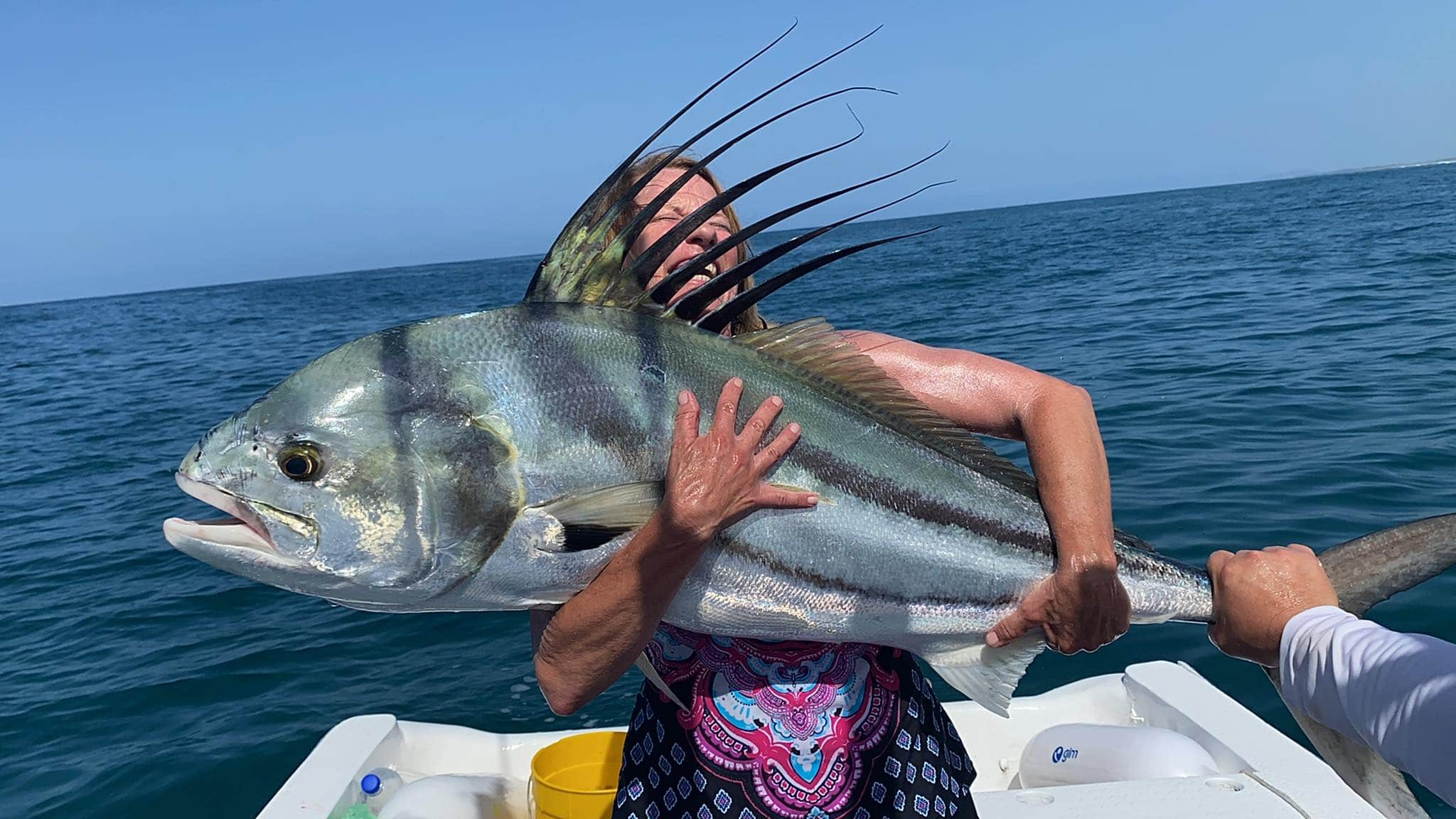
A nice 40 pound rooster refracted in the sunlight/water.
The inshore action is still excellent for roosters. Plus, we are still averaging at least 5 different species each trip out, with large roosterfish being the main target. Adolfo, on the panga Dos Hermanos, has had three pangas out all this week with his group of French clients. He is fishing to the south towards Petatlan, with roosters of over 40 pounds being taken on each panga.
Pelicans, terns, cormorants, and frigates were all feasting on the
sardines cast up on the shore today with the high waves 
Today (Thursday), before I was writing this report up, I was at Playa Blanca. The huge surf was incredible. Santiago asked me if I had heard about the huge surf today, which I said I had seen in person… and, Adolfo said it was like tsunamis all day long.

Ed Kunze (IGFA Representative) 

jueves, 30 de mayo de 2013

Z Fish Report (5/30/13)

A baby whale shark, only a mile off the beach.
The 81° blue water is now only 3 miles off the beach. We are seeing sailfish, dorado, yellowfin tuna, and blue marlin in the daily catches. The numbers are still down a bit, with only a couple of sailfish a day per boat, but we are also just now coming out of the full moon period.

Long time annual visitors John Wilkinson and Jim Heikkinen of Michigan fished offshore with Santiago for 4 days on the super panga Gitana. One day they concentrated on yellowfin tuna, getting 8. Then they fished 3 days for blue marlin. When targeting them, our average here is about a blue for every 3 days on the water, and the 3rd day saw John battling his 1st ever blue for 3 ½ hours to get the 300 pound fish to the boat.

Jim (left) and John with a double while fishing with Santiago 
The inshore action has been excellent. We are averaging at least 5 different species each trip out, with large roosterfish being the main target. Even with the high surf we had most all of this last week, and the full moon, we still got quite a few fish.
Santiago holding Jim's large rooster


John and Jim also made the long run to Puerto Vicente Guerrero with Santiago on the Gitana. Due to the high surf they trolled live bait out in the “safe zone” and got 5 nice roosterfish and several jack crevalle, with one of the roosters estimated at a minimum of 50 pounds.

Another long time visitor and fisherman, Keith Paul of Minnesota, fished a day with Adolfo on the panga Dos Hermanos. They fished the areas down by Valentin (pronounced Balen- teen) This is what Keith had to say about his day on the water with Adolfo: (But, first I need to remind you Adolfo and his deck hand Jesus (pronounced Hay-sooz) are a fish catching machine. Normally two people fish with them and not alone like Keith does. This gives time for a person to fight a fish, and the other to recover).

“I had to ask Adolpho for the final count, because the bastard fished me into the bottom of the panga! LOL…We got 13 jack crevalle in the 6 pound range, 6 normal sized black skipjack tuna, 4 needle fish, and 4 roosterfish around 15 to 25 pounds. My freakin arms are jello.
Keith with one of his roosters fishing with Adolfo
Around 11AM I told him one more fish and I'm done. Don't care if it makes me a pussy or not! So of course four Jacks later Adolfo laughs and says “Okay. Finito!” As we are running back towards the white rocks, the birds catch his eye, and we pulled over to catch 5 bonito in 15 minutes. I even made him reel the second to last in!!”
Adolfo (photo by Keith)

While Adolfo was “abusing” Keith, John Wilkinson and Jim went down to Puerto Vicente Guerrero with Cheva and me. Because of the high surf, we decided to fish my sweet spot, which is an hour down below the point. The rock hump comes to within 25 feet of the surface and a mile off the beach. We were doing fantastic with a huge rooster (which a large needlefish cut off by clipping the 50 pound bite tippet), a large rainbow runner, black skipjack, several misses on jack crevalle, etc.
Jim with his nice rainbow runner
And, then we had the incredible experience of a baby whale shark of about 15 feet long come up right at the corner of the panga. He even made a turn and came back from the direction of the bow. We could touch him. But, the game fish did not like the idea of him being there and took off. Even though the whale shark is harmless to them, they feel if something is bigger, it will eat them. So we went back to the surf line and managed to hook a couple of more roosters breaking about 300 yards off the beach.

On Wednesday, Keith wanted to see Puerto Vicente Guerrero and sample the fishing there. Knowing the surf had died down; we optimistically went down there again. We started getting into game fish at our No. 1 spot almost immediately.  
With Abel at the tiller, Keith is holding his sierra
There was bait, porpoise, birds, and all kinds of life. A nice 8 pound plus sierra for dinner was the first fish, and then a pair of false killer whales moved in on us. Poof…the game fish disappeared….again. No matter what we did, we couldn’t shake the predators. Fist we fished the area thinking they would move on, but they didn’t. Then we would gun the motor to a new area for 10 minutes, and they showed up 30 seconds later. 


We finally had to give up and fall back on plan “B”. Around the point and on the same beach, which was our plan “B” with John and Jim two days earlier, we finally started getting roosters and jack crevalle from the surf line.  We ended up with a very decent day.
Ed Kunze (IGFA Representative)

Another of Ed’s Observations: When the surf is high and dangerous, the roosterfish and bait do not like it either. Under these conditions, having live bait on board can make the day. The schooled bait moves out a couple of hundred yards from the shore line, and the game fish follow.  We managed to pick up several with our popper spin rigs when we saw breaking fish about 300 yards off the beach, but we were lucky. When there is high surf and no breaking fish on bait, trolling a live bait is very effective, and one of the few instances I would say it would out produce the surface popper method.  

When roosters and jack crevalle are in the 8 to 12 foot deep zone, and just at the back edge of the breaking waves, they are there for a single purpose. They are actively feeding. When they have their fill, they head back out for the safety of 30 to 100 foot deeper water.  A boat cannot troll a live bait in the active feeding zone, but casting a popper 60-80 yards with a spin rod can reach them, and will outperform live bait.

jueves, 23 de mayo de 2013

Z Fish Report (5/23/13)

Jim Mckenna with deckhand Francisco on the Gitana

With 81°water returning to the inshore and along the beaches, and the 84 to 85° water hugging the 100 fathom line at 5 miles, the fishing has been improving. But, with a reverse parody, there are fewer fishermen here to take advantage of all the options present now.

The offshore fishing is seeing a couple of sailfish per boat caught per day, a few dorado are showing, with both striped and blue marlin being taken. And, the small yellowfin tuna are still hanging around the 1,000 fathom curve.

Jim McKenna of New York fished 3 days this week in the blue water with Santiago on the super panga Gitana. They released 6 sailfish, 1 striped marlin (estimated at 140 pounds) and 10 football yellowfin tuna.

Adolfo, on the panga Dos Hermanos, reports good inshore action for all areas north and south. The water is warm and clear, and the roosters are back.  When I was talking to him on his cell phone while typing this report, they were into heavy sierra and jack crevalle action up at Troncones.

Ed Kunze (IGFA Representative) 

jueves, 16 de mayo de 2013

Z Fish Report (5/16/13)

Brian O'Hara on the Gitana
As I predicted in my last report, things are getting back to normal this week. The 80° blue water is only 10 miles off the beach; with 84° water still pushing northward. The 84° warm water is now out in front of Vicente Guerrero. It was in front of Acapulco last week, which means it is moving about 50 miles a week. It will be here next week.

The offshore fishing this last week has seen a decent improvement also. There are several boats going out and getting 8-9 strikes on sailfish a day. Dorado are again in the counts, and lots of football size yellowfin tuna are also showing from 40 miles on a 240° heading on down to 30 miles on a 180° heading.
Brian with one of his four sailfish released
Early in the week, Dennis Baily and Greg Taylor from Ohio went out 30 miles with Francisco on the super panga Huntress. They had a nice double on sailfish, which they released, and lost a couple of others.

Brian O’Hara of Washington DC fished with Santiago on the super panga Gitana on Wednesday and released 4 sailfish the first day. The second day they went to the beaches down by Valentine for jack crevalle and black skipjack on the fly rod. The third day they went out 45 miles getting 4 small yellowfin tuna on the fly rod and a 35 pound tuna on live bait.

Francisco on the super panga Huntress also fished on Thursday, and saw the conditions improving for his Canadianclient over what they experienced with Dennis and Greg last Sunday. They got 8 strikes on sailfish between 19 and 20 miles, and a strike on a huge blue marlin at 13 miles. They caught and released 4 sails, with 2 getting off. They had a triple, a double, a single hookup and another double.
As Abel is about to release this rooster, note the foam from
the heavy surf, and how far off the beach we encountered
the school of roosterfish.
Inshore action has also improved as the water is warming up and getting clear again. Dennis and Greg spent a day with me down at Puerto Vicente Guerrero for roosters.  We got there and encountered huge surf, which proved to be non-productive factor when we started fishing a couple of miles to the north of the port. We then made the move to around the point and a couple of miles south. Because the surf was high, the roosters had moved off the beach. We got into a huge school of roosterfish that had over 200 large fish in it. They were breaking on the surface like tuna, with the exception the huge namesake dorsal fin was raised and slashing the water as they chased their prey.
They were swimming and crashing on bait only a few feet
 from the  boat
The first frenzy was the largest, but the birds told us where they were for the next two hours. We ended up hooking 5 roosters. And, you ask “where are the photos of this incredible experience?” Well, Dennis and Greg were either trying to catch a rooster or fighting one. The captain was busy with maneuvering the boat position, and I had a damned pelican on the lure end of a spin rod. The pelican flew into the line and got wrapped around the wing and across the back. The frenzy was over in just a couple of minutes, and it took me that much time to get the pelican close to the boat to be released unharmed.

Ed Kunze (IGFA Representative)

Another of Ed’s theories: We seem to only experience large schools of roosters in November and December. They are fairly much gone from Christmas through May, with June being one of our best months for roosters. Normally, from June and on into December we catch them in shallow water off the back side of the waves as they are loosely scattered along stretches of the beach.  The smaller roosters do cluster in groups of 5 or 6, but the larger fish seem to be alone or as mating pairs.

By encountering this large school of roosters this week, was it a migrating school of returning fish? Are the schooled fish of November and December being pushed down from the north by cold water and migrating to points south? Basically what I am asking is if large roosters are more solitary or mating paired fish, but the schools we have seen all have huge fish in them, do roosterfish school up when they migrate, then disperse into loose groups after they arrive to the area they call their summer  (or winter)home? There is some precedence to his. In the animal and bird kingdoms, this does happen with several species. I hope to explore this question a bit more….Especially this coming November and December.

Or, is it just because the high surf creates a situation where the roosters have a hard time trapping the bait against the beach, and they have to school up to trap them in open water?

jueves, 9 de mayo de 2013

Z Fish Report (5/9/13)

Deckhand Adan on the Super panga Gitana with John and Justin 
The 80 degree blue water is still following the 1,000 fathom curve at 30 miles. The inshore water is as low as 74 degrees and holding on out to 5 or 6 miles and following the 100 fathom curve. Looking at a larger picture on the Terrafin Satellite photos, I see warm and clean water pushing up from the south, and already at Acapulco. Our conditions should be favorable again by the end of this next week.
Yellowfin tuna out of Puerto Vicente Guerrero

The
offshore fishing this last week was mostly about the 3 day sailfish tournament. With 126 boats entered, they covered the local water as well as it can be covered. In summary there were 2 to 3 sailfish caught per boat over the 3 day tournament. The majority of the fish were under 30 kilos (66 pounds) and not eligible for weigh in. With last year’s tournament won by a known long line fisherman and this year’s additional controversy of a couple of politicians placing in the tournament (it appears the rules were bent a bit for them), hopefully this kill tournament will lose the luster it held in the past and will go away.

As far as the fishing went, it was very spotty with the fish concentrated in areas holding bait. A perfect example was Santiago, on the super panga Gitana, fishing with Flip Himmelreich and Dave Wisdom from Spokane & Portland. They caught only 1 fish on the 1st day, none on the 2nd day, and then 6 on the last day.

Normally it takes a week or so after the tournament for things to settle down, but on Wednesday Santiago went back out with John and Justin Strumilla from Toronto. They released 3 sailfish and landed a very nice 45# dorado.
Sam Gammy and Mike Frehlick with a huge dog tooth snapper
Inshore action has been on the slow side up here around Zihuatanejo. Adolfo, on the panga Dos Hermanos, just wrapped up 6 days straight of fishing with his French client. Daily they were getting sierras, chulas, and jack crevalle, but they really had to work for them. They found huge jack crevalle out in front of the White rocks, plus a bunch of chulas they were able to troll up in the same area.
Sam Gammy and Mike Frehlick with a double
Another
John Lorenz, of the fishing lodge Bahia de Tortuga, down at Puerto Vicente Guerrero provided an incredible week for his clients Sam Gammy and Mike Frehlick of British Columbia. Trolling deep diving Rapalas inshore, they scored on roosters, jack crevalle, and dog tooth snapper. Offshore, they trolled out to 35 miles and found the yellowfin tuna on cedar plugs. They got full limits of tuna for everybody on the boat.

Ed Kunze (IGFA Representative) 

And another


jueves, 2 de mayo de 2013

Z Fish Report (5/2/13)

Theresa and Ken  Meyer with a nice pargo
The blue offshore water is still about the 30 mile mark and basically following the 1,000 fathom curve. However, the colder water is being pushed back up north, with 80 degree water about 13 miles off the beach. I expect things to get back to normal in about two weeks.  The blue water fishing is still slow, but mostly because of the distance and the extra fuel premium needed to reach the fish. People just don’t want to pay the extra fuel, with no guarantees, and the prospect of a long boat ride.

In a way these difficult conditions are very good for the sport fishing industry, because starting this Friday (the 3rd) is the three day 30th annual sailfish tournament, which averages about 150 entry boats each year. It is a kill tournament, and one of the last remaining kill tournaments in the world. Prizes are awarded for the first three places for the largest sailfish, and also for the largest dorado and marlin. In years past I have seen as many as 800 sailfish killed in one three day span of the tournament. Fortunately, with the current conditions, this will not happen this year.
Will Anderson with a small dorado caught while
fishing with Ramon at Mahuaja

The inshore water is also warming up with 80 degree water sowing on the beach from about the White Rocks on down past Puerto Vicente Guerrero. Unfortunately, the chlorophyll level is still very high and almost a red tide condition in a lot of areas. Again, this will all clear out within a couple of weeks. There still are some areas producing, and the worst of discolored water is off the beach a ways. Ken and Theresa Meyer from Albany Oregon stayed at John Lorenz’s Bahia de Tortuga fishing lodge at Puerto Vicente Guerrero and got a nice dog tooth snapper while trolling a deep diving Rapala out in front of one of the river mouths down there.
   
Ed Kunze (IGFA Representative)

For a better understanding of our seasons and species of fish here in Ixtapa /Zihuatanejo, please click on the link to my web site and scroll down on the left side bar for “Calendar”… http://www.sportfishing-ixtapa.com/index.html  


Melissa Lloyd with a nice black skip jack
while fishing with Ramon 
I have also made two new informative web pages for people coming here for their first time. The first is for when you go to the municipal pier in Zihuatanejo in the morning to find the boat you will be fishing on:   http://municipalpier.blogspot.mx/2013/02/the-municipal-pier.html
The second is for people who are looking for a place to stay: http://edkunze2.blogspot.mx/2013/02/places-to-stay.html